
Hello! Buy my book! It is a subversive Irish Mythological Retelling that won the Fantasy Book of the Year and was called “a mastery of mythology” by Independent Book Review. Be a good person and buy it directly, or, if location prohibits, be a decent person and buy the Kindle version.
If you enjoy this, please share it by forwarding this email, sharing it on your social media (if you still have one), or sharing it on Substack.
Monthly subscriptions are $6.75. These subscriptions support my writing and this space. It may be a cup of coffee for you, but it is the nourishment that keeps us alive, and we are so very thankful!
Also: Buy my book!
What this is: a brief study through a weekly linguistic mythology of the ancient Proto Celtic language, the Mother Tongue of all Insular Celtic traditions, derived from my upcoming book, released Autumn, 2026.
Note #1: the Insular Celtic peoples (Irish, Welsh, Scottish, Briton, Manx, Cornish) are threaded between colonial history’s nomenclature of who we are and the hearth-song of our own private liturgies, the ceremonies of quiet winter-breath so much like the snakes that have long run from those who come in big ships bearing big books. The Irish are Éire, us homeless children hearthed, long ago, under the arching sleep—tents of the lush rolling hills and the deep arching lodges of warm wet island forests by the Sovereignty Sisters, Ériu, Fódla and Banba. The Welsh are Cymry of the Land Cymru, meaning “the people” or “fellow landfolk,” but Welsh in the Old English is wealh, meaning “foreigner” and as a noun it means the “strangers” living “over there,” and, not surprisingly, as a verb, spelled welch, it indicates someone who “avoids paying debts.” History is complex and our blood-memory lives with impassible nuance, though I have decided to maintain the colonial nomenclature so as to maintain the accessibility of this text. Forgive me and let us grow together.
Note #2: I am American-born clay remembering the spirit-weave of my ancestors with an Irish grandmother and a Welsh grandfather, my namesake, Ffrith (or Firth). My grandmother’s ancestors trace our lineage in Lowpark, Co. Mayo as far back as the “census” of 1500 CE. I do not claim to be a member of the modern Irish culture and I do not speak Gaeilge, the modern Irish language. But Gaeilge comes from Sean- agus Mheán-Ghaeilge (Old Irish) which I know moderately well and Sean- agus Mheán-Ghaeilge comes from Proto Celtic, which is what I know best.
Cauldron and Metamorphosis
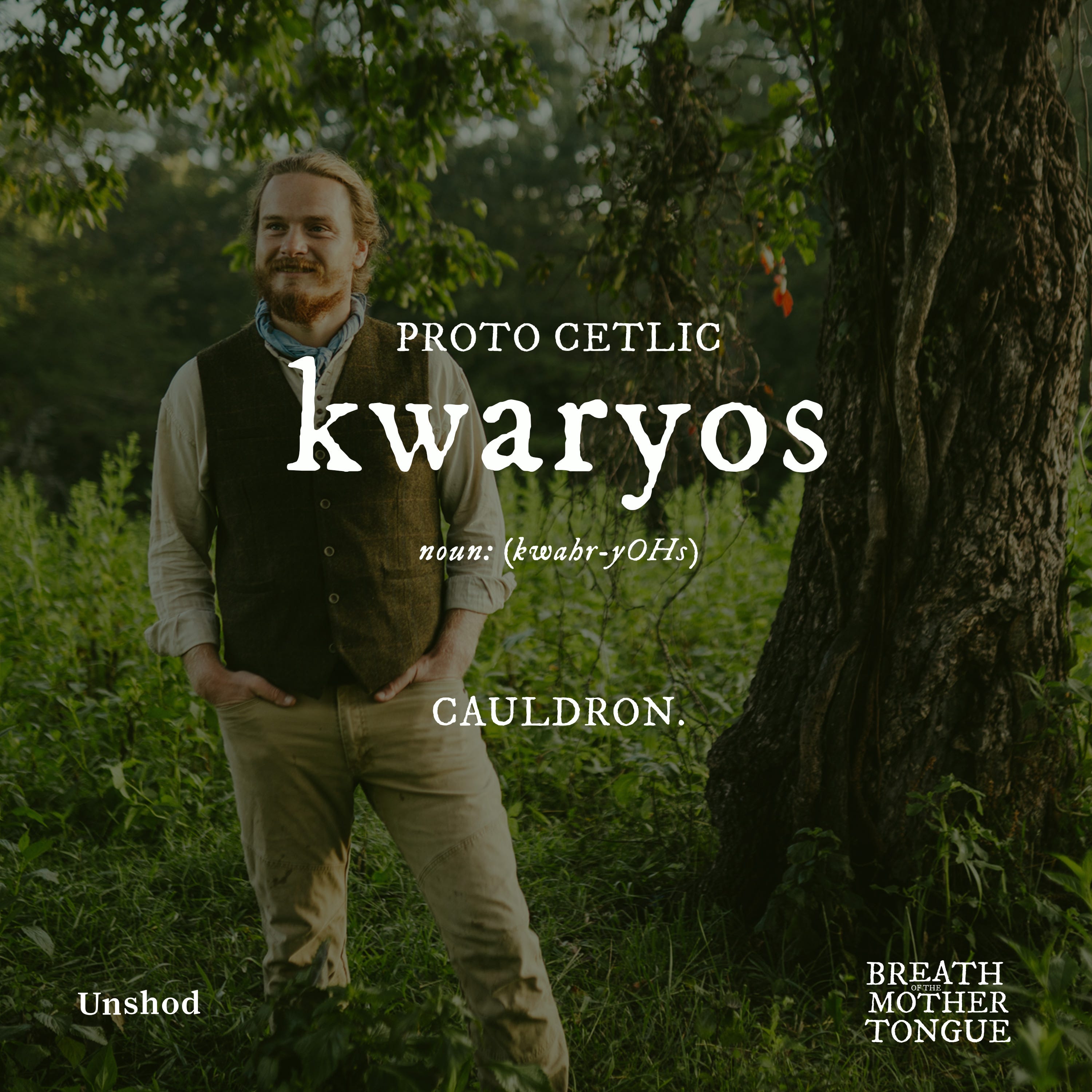
kwaryos (kwar-yOHs): Cauldron. kwritus (kw-rh-IH-tUHs): Metamorphosis1
There is a sacred connection within the Insular Celtic mythologies between cauldrons and change, or metamorphosis. The idea that shapes and bodies are not the same structures but have a relationship that imbues fluid meanings on static forms.
We see this in Insular Celtic stories from the Welsh Cerridwen’s Cauldron of Rebirth to the Irish Dagda’s—otherwise known as Aedh Álainn (Beautiful Fire) or Fer Benn (Horned Man), or in the Proto Celtic Wiros Bandâ—Coire Ansic, one of the four treasures of the Tuatha De Dannan that means something like “Undry Cauldron.”
But what did our long—ago people’s mean by Cauldron? Was it simply a vessel? A container of liquids? Or, perhaps, did they mean something so much more?
A quick dive into ancient Irish mythology yields a pivotal foray under the trowel of linguistics and etymology. In the Sean- agus Mheán-Ghaeilge translation of the Tuath De Danand na Set soim, the ancient—ones say,
“Coiri in Dagda, ni teigead dam dimdach uad, ir.”
Or, translated, “The cauldron of the Dagda, no company went displeased from it.”
Another example can be found in the Harleian MS 5280, folios 63a–70b, an ancient Irish manuscript held in the British in the Catalogue of Irish Manuscripts in the British Museum. In this 16th century manuscript, owing its writing to early 9th century and earlier, undated materials, is a version of the Cath Maige Tuired, or Second Battle on the Plain of Pillars in Sean- agus Mheán-Ghaeilge, or Old Irish. Speaking of the Dagda’s Cauldron, in folio 63a, the author says,
“A Murias tucad coiri an Dagdai. Ní tégedh dám dimdach úadh.”
Or “From Murias was brought the Dagda’s cauldron. No company ever went away from it unsatisfied.”
In both cases, which as you may see are very similar in cadence and terminology, the word for Cauldron woven here in the Old Irish is coiri which runs back from Old Irish into Proto Celtic as kwaryos, meaning “cauldron” in the purest sense and thence into Proto-Indo European (PIE) as *kʷr̥-yos from the root *kʷer-, meaning both “vessel” and, most interestingly, “to make,” or “to build.” This is where it becomes interesting…and sacred…
Some scholars have offered that the PIE *kʷer- is a synonym with the PIE *h₂er-, which means something like “to prepare” or “to make ready,” another interesting weave-bundle that allows the ancient Irish idea of Cauldrons to mean something like “the body that makes and remakes.” What a staggering difference there is between a living body and an inanimate vessel.
This definition found through this weave is similar to the modern Irish word claochlú, meaning “metamorphosis.” As it often happens with sacred and good medicine weaves, the long—ago people’s spirit does not stop here, for claochlú appears to run back through to Proto Celtic as kwritu which also means “magikal transformation,” or, more simply, “metamorphosis.” Kwritu is rooted in the PIE *kʷr̥-yos from the root *kʷer-, the same Grandmother term as Cauldron, or kwaryos.
In this way, there is threaded breath, a single heart-beat, a balanced circle of etymological and spiritual life between the Irish/Welsh Cauldron and the fluid idea of Metamorphosis, or shapes being remade in bodies, or vessels.
This can also be seen in the Lebor Gabála Érenn and many other bundles of Irish mythology—the idea of “shapes transformed into new bodies,” as Ovid wrote all those years ago, the balanced beauty of Cauldrons and Transformation.
If you enjoy this, please share it by forwarding this email, sharing it on your social media (if you still have one), or sharing it on Substack.
Monthly subscriptions are $6.75. These subscriptions support my writing and this space. It may be a cup of coffee for you, but it is the nourishment that keeps me alive, and we are so very thankful!
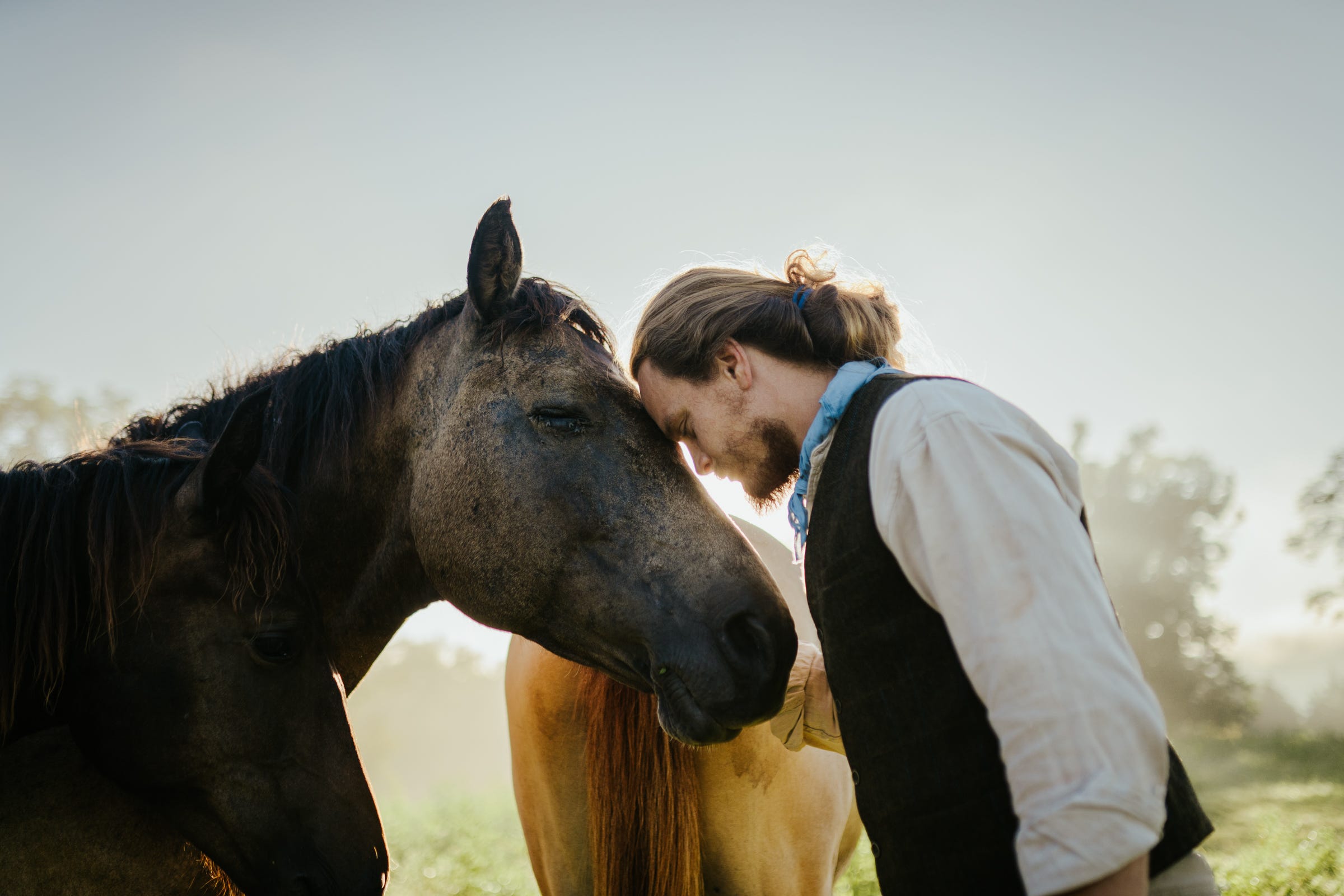
Ffrith is markâko and learning seanchaí, a participant citizen of Earth Mother: a father, horse-friend, sacred butcher and leather tanner, magikal storyteller, and award-winning indie author of six books on kincentric ecology, mythology, fantasy, and horror.
This is not a scholarly linguistic study or etymological defense for deep, academic purposes. My name is Ffrith and my name has no other letters after it. Let the white towers have their rice-skinded tomes and technicalities. This is a dream, a vision found in a ceremony of days, a story crafted like a ballast of sacred breath told after supping with the long—ago peoples.