
Hello! Buy my book! It is a subversive Irish Mythological Retelling that won the Fantasy Book of the Year and was called “a mastery of mythology” by Independent Book Review. Be a good person and buy it directly, or, if location prohibits, be a decent person and buy the Kindle version.
If you enjoy this, please share it by forwarding this email, sharing it on your social media (if you still have one), or sharing it on Substack.
Monthly subscriptions are $6.75. These subscriptions support my writing and this space. It may be a cup of coffee for you, but it is the nourishment that keeps us alive, and we are so very thankful!
Also: Buy my book!

Introduction
First, a prayer in the Mother Tongue: “klinu mewe ɸari-kaneyo, kwenno-windo! Wiḱpótis bawano uɸor sin esweid. Adkwiso sin maljo kwe uɸelo. Wor-moniyo âg mî, dîgalâ sin kei gdonyos kwei gabyo ɸro ɸelou. ɸarna mî nerto.”
Or “Hear my song of sorrow and seeking, white-headed-ones! Sun smiles this spot. Sees the wrong and evil done. Rise (higher than mountain) with me, punish those who take too much. Give me strength.”
This is an unbridled letter.1
This is an unbridled letter, composed under the white cloth-glass of Briganti’s frost, the daughter of the Dagda, weaving her lace about Earth to warm and welcome all with her gentle hearth-fire.
This is an unbridled letter, an adkenî2 screaming like cross-blown breath through a bone flute, which is also a marwonatus3: a death-song climbing the sacred fire like all orthodoxy is just kindling to Earth’s requiem, skinning the dirge and flaying all vestments like the grey gossamer gauze of moths.
Ar scáth a chéile a mhaireann na daoine.4
Join in.
When a Tree Grows Two Hearts
Many feet below her southward crook a new heart develops, silent and placid. It grows untended, unseen, unknown. Is a grey-brown pillar against praise, a barky tiff against haste, a soundless argument against the time’s roaring and tenuous tether to being seen, being known. A new heart for new rings to cling to, layer on layer, year over year. She didn’t ask to be seen, probably doesn’t even want me telling you now, but I saw magik that day, I held the sacred music so much like sawchips and dust in my hands and it caked my sweat-laced clothes that I wondered where the magik started and where it ended, it was strong, aromatic, wonderful to the point that I have to tell you about it…
This is a tale of counting tree rings and being counted by them too.
A Shortcut with Mushrooms
Counting tree rings is like counting anything else, I suppose, but each ring’s story is unlike everything else you know—they are the patterned personalities painted in undulating strands of strength, weakness, and the cambium’s fight against drought and death.
But the battle is not single-combat, like Beowulf and Grendel, Menelaus and the prissy and Aphrodite-coddled Paris of Troy. No, trees are better than our heroes who fight to live, or fight for glory, or fight for some woman’s love, for they live to fight for each other, though they don’t ask to be seen or for epic tales to be written about them. This is not an epic tale, but it is a tale of an epic tree, and I pray it is good enough.
In her 2021 book, Finding the Mother Tree, Suzanne Simard summarized her life’s work, demonstrating that trees fight for each other—that, in the networked and highly-connected communities of forests, roots and their fungal friends co-create a life that pulses, and pulses with intentionality. In an interview with the Yale School of the Environment, Simard summarized that it is “sort of like a below-ground pipeline, that connects one tree root system to another tree root system, so that nutrients and carbon and water can exchange between the trees.” Interactions between organisms is emblematic of Earth and her wonderful network. Even Aristotle’s division of sublunary life understood this.5
But fungi facilitate and speak of a deeper connection, a virtue beyond our human-heroes’ scruples.
If anything, they also question our ideas of what it means to be “a thing.” Fungi seem to facilitate or form a shared circulatory system throughout all of Earth’s children, blurring the lines as they go, slithering by, busy in their work, our life. This was questioned in the late nineteenth century, matured by Swedish botanist Erik Björkman in the 1960s, and then developed in the field by David Read and Suzanne Simard in the early 2000s. This wood wide web, fungi’s deeply woven and layered fabric connecting and covering life, is a seemingly ministerial but not reductionist system of community and connection that benefits the fungi, the soil, and the many plants rooted in its warm and healing womb. Perhaps the most surprising property of life’s web is its ability to enfold organisms together in place of separating, isolating, self-identifying…
Like tree rings.
Simard found that a plant’s root tips are clothed in fungus and “any water the roots would be accessing, or anything soluble in water for that matter, such as nutrients,” filter through the soil and its joining fungi as a two-way energy switch. From the root myco, like fungus, and rhiza, like root, Mycorrhiza fungi perform a function in Earth’s womb by stepping beyond their own biological nature and becoming the roots of the plants themselves. Arbuscular mycorrhiza go so far in this selfless act of becoming that they grow inside of the roots and within the very cells of grasses, whereas ectomycorrhiza grow on the outside of the root’s cells in trees and shrubs. To make matters even more complex, monotropoid mycorrhiza grow as epiparasitic pegs in the host plant’s cell walls but they never actually penetrate them.6 Arguably the most famous monotropoid is the enigmatic Ghost Pipe, or Monotropa uniflora, that extends their pallid-white fungal and flower-topped phallus out of the forest floor and under beech and oaks during the early to mid-summer here in Virginia.
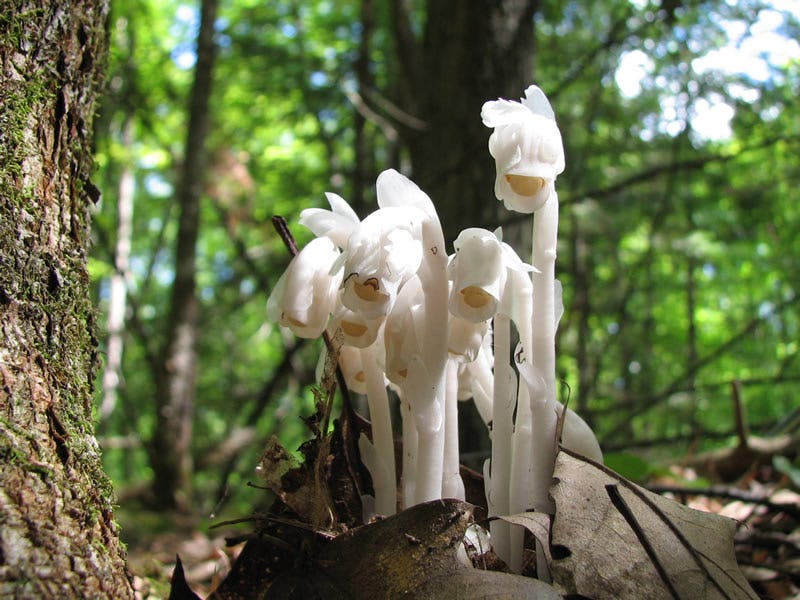
Fungi are complex organisms with ancient associations. Different fungi do different things like digesting pollutants and nibbling on rocks to making medicines that heal and poisons that destroy. In 2017, a team led by anthropologist Laura Weyrich discovered in the El Sidrón Cave in northern Spain that Neanderthals over fifty thousand years ago self-medicated their dental abscesses—bacterial infections of their teeth—by ingesting fungus. Inferred from the archeological and DNA record of dental remains, Weyrich concluded that ancient humans intentionally let herbaceous material mold and then consumed the resulting natural antibiotic, Penicillium.7 At the molecular level, argues mycologist Merlin Sheldrake in his bestselling book, Entangled Life, fungi are “pharmaceutically prolific” and humans are similar enough to benefit from and share our mycelial cousins’ “biochemical innovations.”8
Some fungus even augment Earth’s atmosphere. Fungi explode spores—reproductive packets like a plant’s seed—through what botanist Levi Yafetto calls hydrostatic squirt guns. Podospora, a genus of fungi found in herbivore dung, has been measured to explode at 1.8×10⁶ m s-2, or 4,026,485 miles per hour. That is five thousand times faster than a modern jet needs to fly to break the sound barrier and create a sonic boom. The volume of these spores equates to nearly five hundred blue whales.9 This airborne and fungal mass is found in clouds and triggers weather systems. Most strikingly, this great and entangled and explosive mass lives at your feet and we rarely even notice them.
Like tree rings.
Ecologists consider beneficial relationships between species as either symbiotic, commensal, or mutualistic. Symbiosis is when two species come together for the benefit of one or both; commensality is when two species come together for one to benefit and the other to remain unchanged but unharmed; mutuality is when two species come together for everyone to benefit. Like human heroes in single-combat, the direction of the end is brought on by the means.
But Mycorrhiza fungi, in all their complex forms, do something else—they do more than co-create or co-exist with a plant’s root systems, they do more than see life as a polarity between good and bad, death and life, they step beyond themselves and become the plant’s root systems
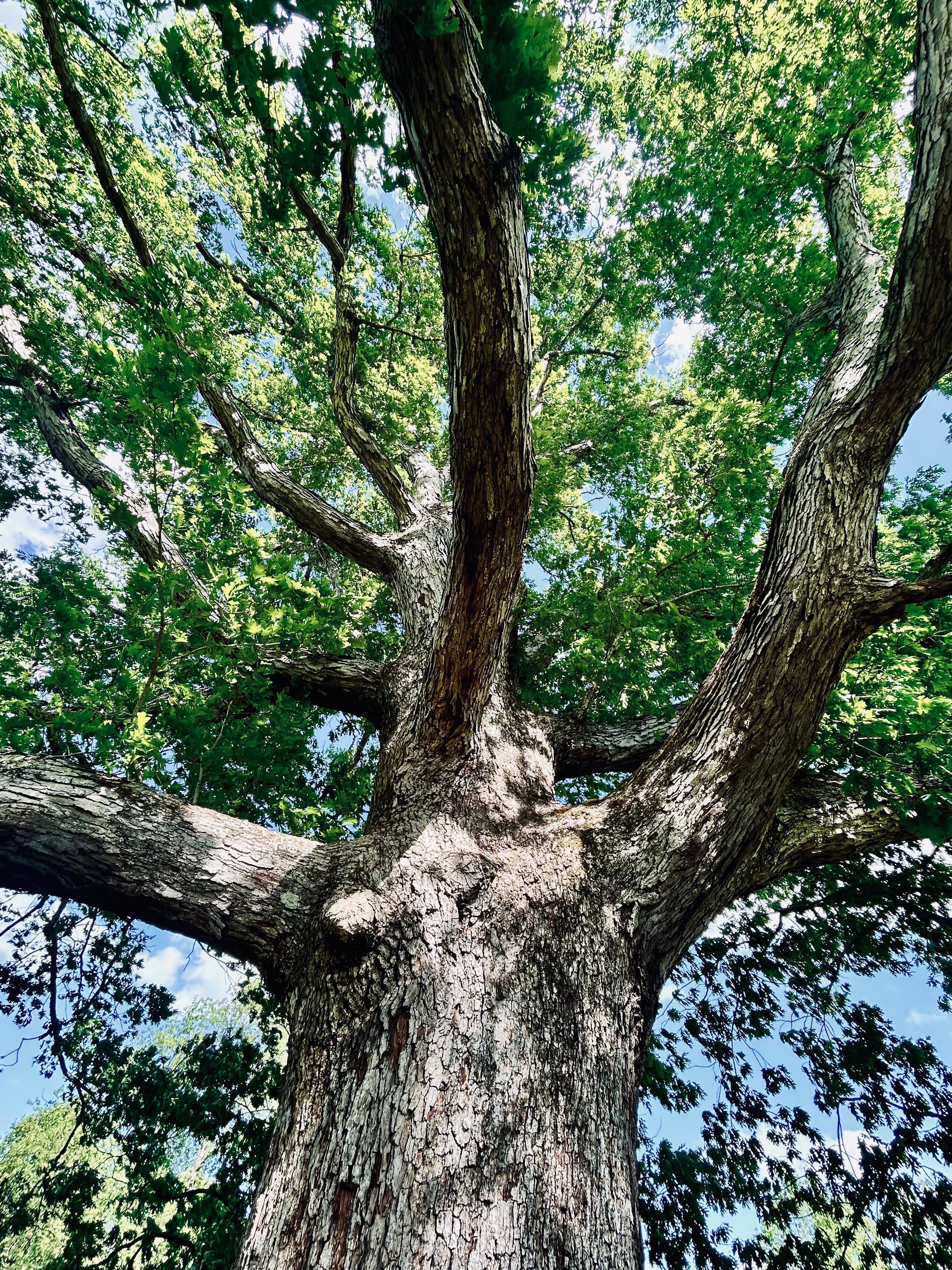
Although the reason is scientifically unclear, it seems that it is more efficient to invest energy in befriending fungi than to invest energy toward the growing of more roots. Plants invest up to thirty percent of their energy (carbon) in their fungi friends. Mycorrhizal fungi are fifty times finer than a tree’s finest roots and can grow nearly a hundred times farther. This is because fungal networks have thin walls, lack cellulose and lignin, and thereby require less energy to develop and sustain themselves.
But this is also because friends make light work of life and fungi seem to be the best of friends.
Like time and tree rings.
The fungi, who lack photosynthetic abilities, trade with trees by sending their mycelium throughout the soil to harvest nutrients and water and bring those nutrients back as plant-available forms to the trees in exchange for photosynthate. The fungi utilize this sugary meal to expand and sustain their great wood wide web of mycelial threads and tunnels. As they expand, the nutrients and communities the plants have access to also expand and the system becomes increasingly complex, communicative, and resilient. Like two armies working together instead of killing each other.
But it is here that it all also becomes quite confusing—where does one tree start and another end? Community and its gift, the two-way energy switch that sustains and enmeshes the eons.10
You see, when we look at trees, we must dive into the deep and reticent silence of rings; and when we splash in the sweet mucus of rings, we end up hurled off our humanness and limping, roiling, tumbling with the moisty-love and intimacy of fungi.
For we humans are, as they say, just fungi who took their clay with them…like trees.
The Tree’s Southward Crook
The tree is waiting for us and I said earlier that counting tree rings is like counting anything else. But I think I was wrong. For, if I was honest with myself, I would say that it is not like counting at all but telling those sacred tales that lap the hearth-flame like a salik’s11 shadow over river trace. Counting is holy work when the numbers go missing.
Looking at the rings, I see she worked long and stead against this wind-stress of many seasons, buffering through constructing defenses and basal buttresses. Her cambial cells on the leeward side compressed into wide and denser rings to push against the wind—spirit’s forces. Some tales are memories of famine and pain when bedlams and their marvelous, thundering beasts ravaged and cracked downward against her arithmetic form and flooded the landscape with tiny oceans or burnt deserts. Here, our tree worked to conceal her strength and she slept, preserving herself as the landscape slept around her. Her cambial cells grew with nearly imperceptible stories of this time but she lived as those who also live under the dreamlike slumber of a sunny, summer afternoon—just enough to be alive and just enough.
But therein lies the riddle—her mythological enigma fed with Mycorrhiza’s fare and writ in her cambial growth. While her cells yearly divided into successive layers that became packed and nestled into her always-building base from the outside in—this is the fundamental process involving cambial growth as tree-ring formation—her new heart seemingly developed from the inside out. It emerged in the trunk of our tree without a previous story, without a mythology or tale of its emergence. It appeared without warning.
It went like this. Her splash rippled across the lowland valley and the hum of saws echoed against her still-standing relations. She fell to make way for a lowland and spring-infused pond and she fell to form the foundation for our new home. Her memory would be sound and song for many generations. We worked to separate her many years into many, hand-hewed logs and around seventy feet from her base, she stopped us in our shoes.
About ten feet below her canopy’s crook, her singular heart became two in form and equal in size. The tree had two hearts but only one trunk…
Trees, not unlike their bipedal cousins, have only one heart and you can see the heart when you take a cross-section of their great trunks and look downward at it like a red-tailed hawk looks downward at you. Rings upon rings ooze inward and grow dry and strong as they dive deep into the dark, blood—waters.
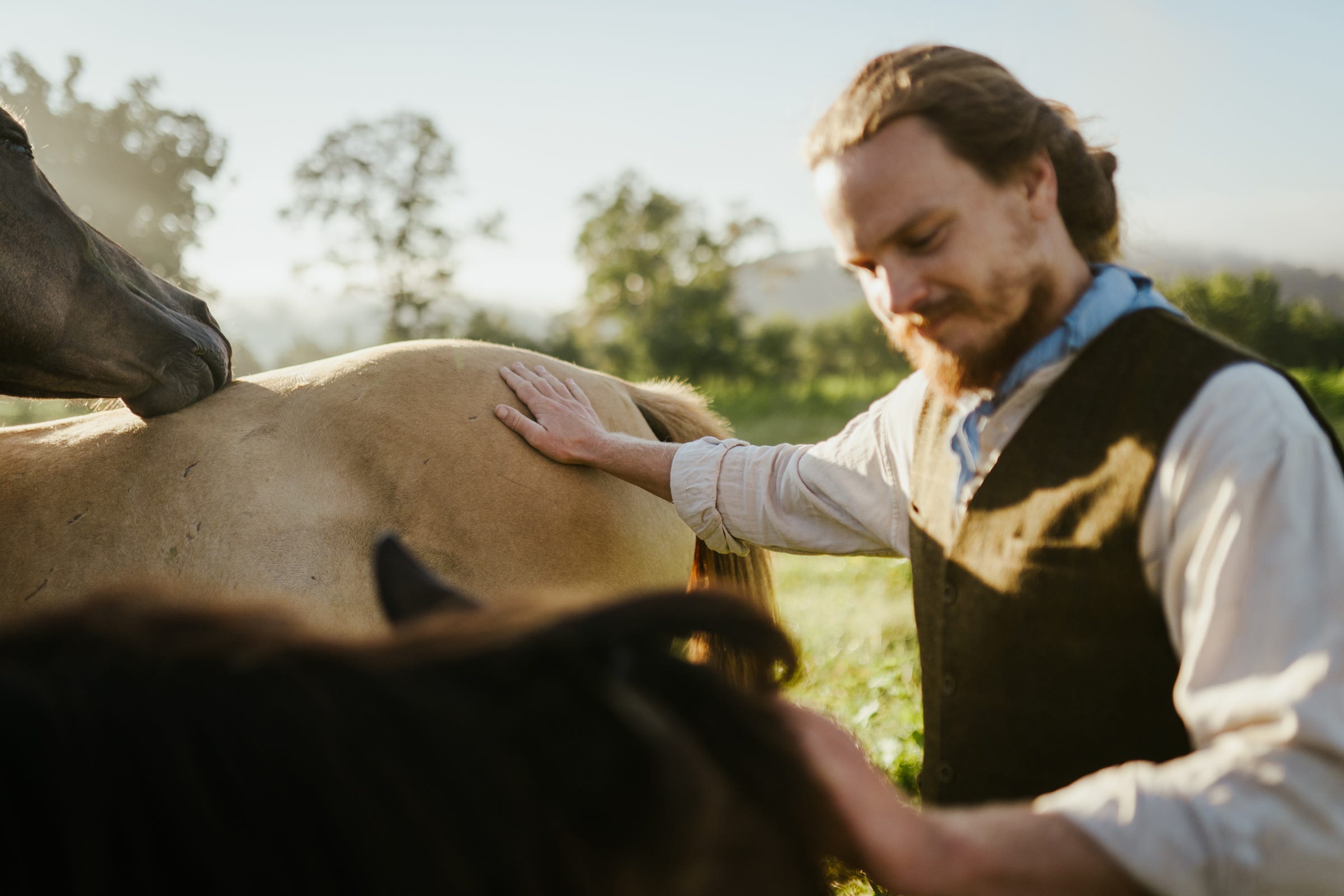
But, as I said, around seventy feet from her base, her heart split in two. It happened within the span of about ten years in total, by my calculations. While she had grown for nearly one hundred and fifty years with one heart and one trunk—one singular story of rings emerging from her deep and dirt-colored core of cambial memory—here she decided to do something else. She split her heart in half and gifted it away.
Like Mycorrhiza.
This was not entirely a strange thing, for trees are loving friends (as I said above) and our Plant Kin give much of themselves away to anyone who dares to ask kindly, humbly. No, the strange thing was that she did this about ten feet below the crook in the canopy. That is, about ten or so feet before she would need this second heart, when she would send a new leader to run side-by-side with the old, stretching this way and that to throw more leaves and her green-yellow love at the increasingly color-less world all around her.
When a white oak develops skyward, their heart becomes complex in chorus and shifts this way or that to support a diversity of limbs in all directions. Large, new limbs evolve small, new hearts to sure their growth and ensure their strength against the bedlam of westerly winds and their thundering beasts. But her heart split many feet below the point where the crook physically developed. It split years before her future, new limb would need it, that is, years before the new main limb required her gift to grow as it grew.
She did this, consciously. Let that sink in. The tree consciously grew a heart she knew she would need…in the future. And she did this from the inside out. While the singular trunk of our tree worked in the wind, her heart split and two trees worked in her core’s loving heat. She grew against the outside-in and cambial flow of life that writes in rings and takes today into memory, she grew from the inside-out and in ways that she need not to grow but she grew and her growth became a testament to her loving life.
Are limbs extensions or rather children of the mother tree? Science tells us that they are extensions. Our friend, the mother oak, tells us something different, for her heaved heart’s now diminutive size silently speaks.
That trees grow is good; that their growth is tellable in their time-told trunks is fine; but that their growth is ever more complex than our simple and scientific stories allow is altogether wonderful. Our friend oak is a visionary. While her growth rings tell a tale of relational locution sustained over great time, her splitting heart speaks to a vision of a future, her future. What we saw was not a response, but a decision.
There is no point here. But if there was, it would be to slow down when a saw or axe enters your hands. Maybe even to ask why its there. For this is not single-combat, although logging crews sound great booms and metalic thrums all about, facing their giants against trees.
Foresters must also be medicine men and woman. To ask first, that is the ceremony of the saw, but true knowledge comes from listening, waiting for the response, for you are not the only one with a forest-plan.
If you enjoy this, please share it by forwarding this email, sharing it on your social media (if you still have one), or sharing it on Substack.
Monthly subscriptions are $6.75. These subscriptions support my writing and this space. It may be a cup of coffee for you, but it is the nourishment that keeps me alive, and we are so very thankful!
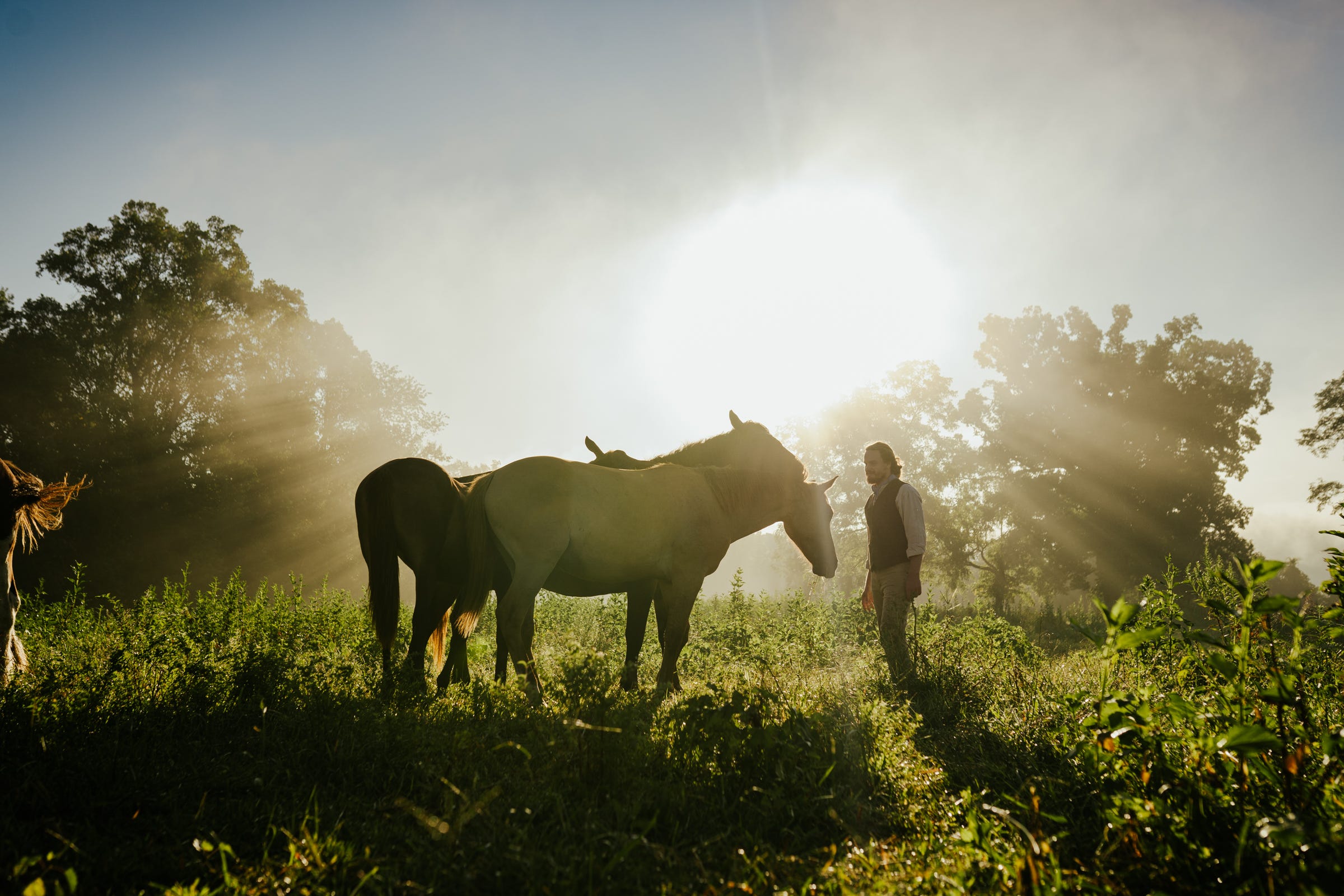
Ffrith is markâko and learning seanchaí, a participant citizen of Earth Mother: a father, horse-friend, sacred butcher and leather tanner, magikal storyteller, and award-winning indie author of six books on kincentric ecology, mythology, fantasy, and horror.
Read Doireann Ní Ghríofa’s A Ghost in The Throat to understand this inspiration and plagiarism.
Mother Tongue. Proto Celtic, meaning “lineage (ancestral web weaving your life and place).” A similar word is used in the Indigenous culture of the Māori. “Whakapapa” is the core of traditional mātauranga Māori.”
Mother Tongue. Proto Celtic, meaning “funeral poem.”
“We live in each other’s shadows.”
Aristotle divided sublunary life into three classifications: plants, animals, and humans and gave each a corresponding soul-type. Plants, he wrote have a vegetative soul; animals have a sensitive soul; and humans, we have a rational soul. He ascribed the weight of their difference in the observable fact of their effects. Plants reproduce for the continuation of their kind and they do nothing else; animals have a certain level of observational capabilities but occupy the lowest possible levels of cognitive and cerebral function and lack both vice and virtue—and so “neither has a god;” humans are rational and our rationality allows us to think, to believe, to experience, to love, to know, and, most importantly for Aristotle, to rule (Aristotle, The Nicomachean Ethics, Translated by David Ross, Oxford: Oxford University Press, 1998. 159; Aristotle, De Anima 2.3.414a32-b19; De l’Ame (Paris: Les Belles Lettres, 1966); On the Soul, Parva Naturalia, On Breath, tran. W. S. Hett (Longdon: W. Heinemann, 1936)). For, what is man but a “political animal” and what is the citiless man but an animal “low in the scale of humanity?” (Aristotle, Politics, Book I, tran C. D. C. Reeve (Indianapolis: Hackett), 1998.). The natural or primitive man, Aristotle contended, is animal in soul and is thereby a lesser man.
J.D. Lewis. Mycorrhizal Fungi, Evolution and Diversification, ec. Richard M. Kliman, Encyclopedia of Evolutionary Biology, Academic Press, 2016, Pages 94-99, ISBN 9780128004265, https://doi.org/10.1016/B978-0-12- 800049-6.00251-1.
Weyrich, Laura et all. “Neanderthal behaviour, diet, and disease inferred from ancient DNA in dental calculus.” Nature. 544. 2017. 10.1038/nature21674.
Sheldrake, Merlin. Entangled Life: How Fungi Make Our Worlds, Change Our Minds & Shape our Futures. New York: Random House. 2020. 9.
Yafetto, Levi et al. “The fastest flights in nature: high-speed spore discharge mechanisms among fungi.” PloS one vol. 3,9 e3237. 17 Sep. 2008, doi:10.1371/journal.pone.0003237.
Simard, Suzanne. Finding the Mother Tree: Discovering the Wisdom of the Forest. New York: Alfred A Knopf, 2021. pp. 60-62.
Proto Celtic word for Willow Tree.
Fascinating piece. The insight that the tree consciously grew a second heart years before the limb would need it really shifts how we think about plant intelligence. Back when I was working with sensor networks in natural habitats,we'd see similar patterns of anticipatory resource allocation that nobody could explain. The mycorrhizal connection as a kind of distributed nervous system makes alot more sense than the mechanistic models we were using.
My day lifts every time you share your words... Thanks again, your words are a light to me. Lucky I have read the books you mention, and found them due to you. You educate and delight me, and for that I am grateful!